-
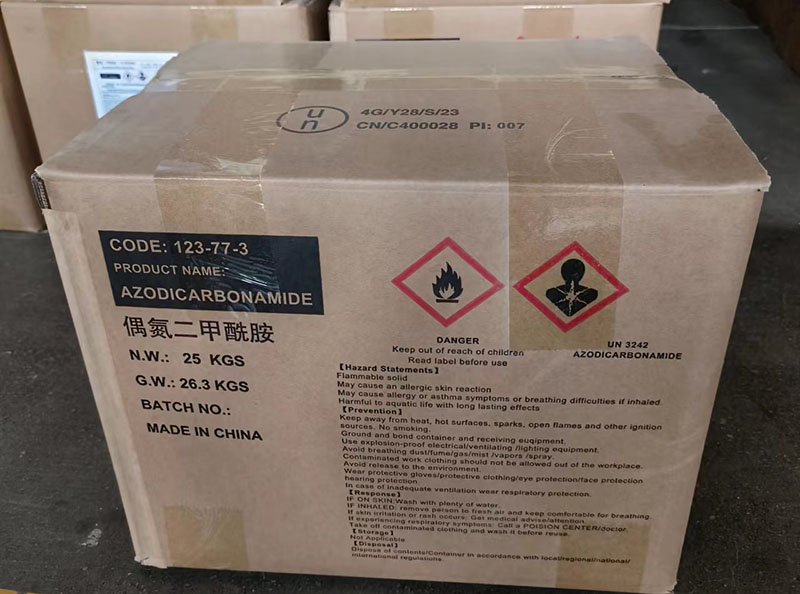
AC Blowing Agent (Azodicarbonamide)
Brand: WSD CHEMICAL
Product Name: WSD AC Series Azodicarbonamide Blowing AgentProduct Introduction
WSD AC Blowing Agent is a high-performance, yellow fine powder chemical foaming agent based on azodicarbonamide (ADC). With strictly controlled particle size distribution and stable gas release characteristics, this product delivers large and uniform gas output during thermal decomposition. It is one of the most widely used universal chemical blowing agents in the polymer and rubber industry, suitable for both atmospheric pressure foaming and pressure foaming processes.
Core Technical Specifications
Item
Index
Appearance
Yellow uniform fine powder
CAS No.
123-77-3
Molecular Formula
C₂H₄N₄O₂
Purity
≥ 98.5 %
Decomposition Temperature
195–210 °C (customizable grades available)
Gas Evolution
210–250 mL/g
Average Particle Size
3–12 μm (customizable)
Partical size index
Key Performance AdvantagesAC Series
AC7000
AC6000
AC4000
AC3000
AC1000
Average Partical
size( Dn ), µm
3-4
4-6
6-8
8-10
10-13
High gas yield, stable decomposition process and no sudden violent gas release
Wide processing adaptability, works well in both atmospheric and pressurized foaming conditions
Low residue after decomposition, no obvious odor or color contamination to finished products
Good dispersibility in various polymers, no local agglomeration or uneven foaming
Main Application Fields
EVA & PE Shoe Materials
Ideal for large-mold hot-press foaming and small-mold foaming of EVA and MD shoe materials, helping to obtain fine and uniform cell structure and improving product elongation and elasticity.PVC Products
Widely used in PVC artificial leather, wallpaper, ceiling, floor leather, profiles and sheets, significantly reducing product density and improving sound insulation and heat insulation performance.Rubber Foaming Products
Suitable for various natural rubber, synthetic rubber and NBR/PVC blended foaming systems, producing soft and elastic rubber foam parts.Other Polymer Foaming
Also suitable for PP, PS, ABS and other thermoplastic material foaming scenarios.Usage Reference
Recommended dosage: 0.1–8 phr, adjusted according to actual product density and foaming process requirements
It is recommended to use together with activators such as zinc oxide, stearate, carbonate and phosphate to adjust decomposition temperature and optimize foaming effect
Mix evenly with resin, filler and other additives during the mixing process to avoid local concentration difference
Safety & Storage
Standard packaging: 25kg /Carton box
Store in cool, dry and well-ventilated warehouse, storage temperature should not exceed 30 °C,Keep away from heat sources, open flames and direct sunlight
Under proper storage conditions, the shelf life is 12 months
MSDS with full safety operation guidance is available upon request
Frequently Asked Questions (FAQ)
Q1: What is AC Blowing Agent Azodicarbonamide?
A: AC blowing agent (Azodicarbonamide, CAS 123-77-3) is a high-performance exothermic chemical foaming agent, widely used in PVC, rubber and polymer processing to generate uniform and stable porous foam structure.Q2: What are the key technical properties of this AC blowing agent?
A: It appears as a fine yellow crystalline powder, with a decomposition temperature of 190–205°C, gas generation capacity of 160–225 mL/g, and features stable storage performance and excellent self-extinguishing property under normal room temperature conditions.Q3: What main gases will be released during its decomposition process?
A: When heated to the set temperature range, it mainly decomposes to release nitrogen, carbon dioxide and a small amount of other inert gases, with white and low-residue decomposition products, which will not easily cause staining on finished products.Q4: What main application scenarios is AC blowing agent suitable for?
A: It is widely used in PVC foamed shoe materials, foamed profiles, rubber soles, yoga mats, EVA foaming, PVC foamed boards and other fields, to help reduce product density and improve material elasticity and cushioning performance.Q5: What is the recommended dosage in conventional PVC foaming formulations?
A: For most general rigid PVC foaming systems, the conventional recommended dosage is 0.3–1.5 phr. The specific usage can be flexibly adjusted according to target foaming ratio, product thickness and actual process conditions.Q6: How to adjust its decomposition temperature to match different processing requirements?
A: You can add a small amount of zinc-based activators to appropriately reduce its decomposition temperature, making it adapt to the processing temperature window of 150–190°C, and better match the extrusion or molding rhythm of different equipment.Q7: What storage and safety precautions should be followed?
A: It should be sealed and stored in a cool, dry and ventilated warehouse, away from high-temperature heat sources and open flames. Avoid long-term accumulation in confined spaces above 120°C, and operators should wear dust-proof masks and protective gloves during operation.Q8: What advantages does this AC blowing agent have over ordinary foaming agents?
A: It has stable gas release rate, high gas production efficiency, fine and uniform cell distribution, low impurity content, and good batch consistency, which can effectively avoid common defects such as uneven foaming, large holes and surface collapse in production.



Whatsapp :
+86 138-5857-5598
 Languages